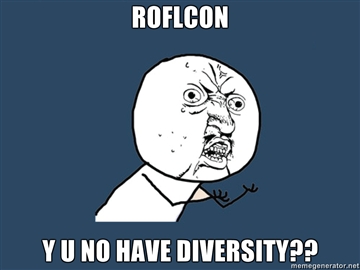
In a week, I will join my dear friends Tim Hwang and Diana Kimball in front of a panel at SXSW, where we’ll be speaking on the experience of organizing this crazy business we call ROFLCon. Like the conference itself, it’ll be part silly, heartwarming celebration and part serious introspection and discussion. And I (gladly! wholeheartedly!) signed up to talk about the only harsh criticism in a sea of loving responses to our creation:
First, a warning: this post is going to be long, and it is going to be more full of Real Talk than R. Kelly.
There are three important things to know about the beginning of ROFLCon.
- I was 19 (Tim and Diana were 20) and not yet very hip to race or gender issues (see previous blogpost and below).
- ROFLCon was intensely personal; to make our first guestlist, Tim and I literally just wrote down everything we’ve ever LOLed at on the internet that we grew up on: Something Awful, GameFAQs, 4chan, YTMND. Places that are predominantly (and aggressively) white, male geeks. There are thousands of other sides of the internet; we picked this one out of personal nostalgia.
- ROFLCon became intentional SLOWLY and not of our own accord. In the bootstrappy beginning, we took anyone that we could get. We dreamed and worked ROFLCon into reality without any idea that it would become an institution of sorts. In other words, we had no idea that our choices would be scrutinized as political missteps, that we would somehow become arbiters of who should or shouldn’t be included in internet culture.
None of these are meant as excuses. They’re just to explain how a staff that was 43% female and 29% people of color could put together a conference with a tiny on-stage presence of either. I suspect this is the story with other conferences and endeavors of love, as well. We should have realized that being the first big, even vaguely serious conference about internet culture was not just a breakthrough, it was a responsibility. But at the same time, how could we have?
We didn’t, not until the day of the conference when people kept raising questions about the lack of diversity, or until we got a handful of critical blogposts thrown at us. The peak of this was, undeniably, Art Fag City’s criticism via/re: Steve Lambert. Here’s what I wrote to the ROFLCon mailing list (as part of a very active, intense email thread that almost everyone contributed to) when that happened:
I wasn’t there when this happened and I did terribly little in terms of organizing this so it’s probably not my place to do this, but I’d like to write an apology to address this on the blog. Or at least on my blog. I think it’s a really fair (if slightly snippy, which to be
honest is totally okay by me) critique.
The staff debated the wisdom of this, and eventually ambitious plans were laid for a series of blogposts from various staffers. But then we all remembered that we had theses due in a month and went back to panicking: college, more liek LOLege, amirite?
But looking back: Art Fag City, you were mostly right, but I hope you know that your vitriol was counter-productive. People are not born understanding these things; they have to learn, even if they’re women. Being really mean to a bunch of sleep-deprived and well-intentioned 20 year olds will create much more resentment than progress, especially if you’re an outsider to our world. There are few enough women in this industry; attacking those that are just starting out is about the best way to ensure it’ll stay that way.
If you’re a commentator trying to shake up the system, being angry at people who create things out of love will get you nowhere. Teach them to be angry alongside you instead.

Toscanini's "Internet" flavor: vanilla with nerds. Photo by Dave Coustan.
So anyway, how bad was our lack of diversity? Out of the 160 people we’ve ever featured or asked to speak at ROFLCon, 26 have been women (16%), 19 have been people of color (12%), and 6 have been women of color (totally embarrassing %). The stats went up from ROFLCon I to II (+1% for women and +5% for people of color). Obviously this completely simplistic sociological inquiry via Google Docs leaves out a lot of other important factors, but overall it suggests a homogeneity that isn’t pretty.
SO JUST PUT MORE WOMEN IN IT RITE?
There’s been a smorgasbord of suggestions for improving diversity at tech conferences, but we aren’t a tech conference. Most of the speakers in general on this Women for your Conference list are totally unsuitable for us: those women are srsbsns, and we just aren’t.
This is a controversial statement, but I want to make it clear: it’s hard to find women that fit the bill for the original ROFLCon agenda because there simply aren’t that many. Women, for the most part, do NOT make the memes that circulate on that particular corner of the internet; when they do, they usually don’t take ownership because it becomes uncomfortable very quickly.
 For ROFLCon II, we tried hard to invite Boxxy, the most famous female user on 4chan: we even called her high school! But she and her family are understandably wary about Boxxy’s fame being tied to her real world identity, not just because of the violent threats. For all of us, it’s a taken-for-granted privilege that what we did in our youth didn’t determine how we would be judged in college and in life; that grace may not be afforded to Boxxy and others like her. As ROFLCon staff Allie Pape put it beautifully over email 2 years ago:
Like it or not, women aren’t doing silly things on the Internet, or deeply personal things on the Internet, without consequences (look at [former Harvard sex blogger] Lena Chen). So I think a lot of them aren’t doing these things at all.
Basically, the nature of white, male privilege on the internet and in the world is that you can do transgressive stuff and become famous for being funny, while most women or people of color who do the same will be attacked and stigmatized for as long as the internet cares to remember simply because they stand out. Their voices get marginalized, drowned out by the furor. That’s why even when they are creators, so many of them stay anonymous, or hidden from the public eye.
Is this indicative of a negative, hostile environment for women and people of color on the internet (and in real life)? YES. Do I want to fix this? YES. Are there people who defy this and do it anyway? YES. Is ROFLCon happy to support them? HELL YES. But, is ROFLCon capable of fixing the misogyny and racism of the internet from which it sprung? …
Are you serious?
ROFLCon has become an important window into the world of internet culture, and it’s certainly in a great position to frame the discourse around the internet to academics & business people, but changing the discourse on the inside? Anyone who spends any significant time on the internet knows that the hivemind gives a crap about what some dorks with badges are doing. Proof? We’ve never been seriously trolled by a trigger-happy Anonymous that reviles those who break Rules 1 &2. Look at the Paypal website. Now look at us. We’re on a horse, in the middle of 1/1000th-of-Anon-thought-we-were-important-enough-to-DDOS land. Thanks, Anon, not just for leaving us alone but for recognizing what many commentators have failed to understand: that in your world, we have no power. The only way to change this culture is through repeated, deliberate participation by increasingly more individuals. Not through conferences.
SO WHAT CAN WE DO?
As the ROFLstaff discussed Art Fag City’s criticism, the ever-wise Kevin Driscoll wrote:
worth repeating: rofl(.+) represents a deceptively specific, small configuration of internet cultures. the complete absence of women presenters this time around is rather brutal but what might it indicate about THIS internet?
The first time Kevin had brought our attention to how deceptively specific and small our focus had been was through the session he pushed through in the first ROFLCon on Soulja Boy.

Soulja Boy performing in front of a screen of fan Youtube videos, from Wikimedia Commons.
To almost everyone at first, the reaction to this panel was WTF??? But Kevin dropped some serious knowledge (in the form of research for his master’s thesis) quickly made it clear why Soulja Boy mattered. Even though he doesn’t fit into our preconception of what a meme was, Soulja Boy’s meteoric rise to fame was all because he had created a huge internet phenomenon. Hundreds of thousands of people of all different races, genders, classes, etc. cranked Soulja Boy to a record deal, and his savvy with regards to engaging his fans through the internet surpasses most traditionally geeky internet celebrities. This is a community that only doesn’t look like ours in that it’s too mainstream.
(Fun fact: moot, the founder of 4chan and probably the world’s leading expert on trolls, considers Soulja Boy to be the greatest troll of all time.)
It quickly became clear that this was the tip of a big, bassy iceberg. The internet’s dance crazes and communities continues to fascinate and delight me, and it serves as a constant reminder that there are tons of communities on the internet that are just as creative and much larger than the geeky archipelago I hailed from. The internet, once the proud domain of geeks, is for everyone now. The globally-connected Ethan Zuckerman introduced us to the idea of “multiple internets” fractured by language and governmental barriers, but it was clear that cultural and social norms were also creating silos of awareness if not of access.
We invited Ethan to share the opening keynote speech at ROFLCon II, and he hit it out of the park with a whirlwind tour of global memes. He implored all of us to play anthropologist rather than bouncer when it came to internet memes: to err on the side of inclusiveness when it came to things we don’t understand, to take advantage of the access afforded us by the internet to explore other cultures (at home and abroad), and to find ways to laugh with rather than at others.

As ROFLCon grows, it expands past the internet of my youth to include many, many other communities. ROFLCon II took small, uncertain steps in many directions out of our comfort zone: towards going globally (booking a flight from Istanbul for Mahir Cagri), towards reaching back into history, towards inviting critical theory to the party (see below). Based on the success of these experiments, we have a plan. To increase diversity at future ROFLCons, we’re not just going to try to invite more women and people of color from the internet: WE’RE GOING TO INVITE MORE INTERNETS, including those helmed by women (and Mexican ravers and queer posthumanists and Chinese vigilantes and skinny-jean-wearing Africans). Why not?
WILL THERE STILL BE LULZ??
Of course, all of this must be done in a way that upholds our proud tradition of excellence. There’s no place for boring on the internet, which is maybe why some of our finer tomes on gender and race theory are, like Milhouse, not memes. And we won’t tolerate any panicking, scandalized outsiders levying blind criticism: even when we’re being critical about something, we want the problems being pointed out by those who understand and love the communities they’re talking about.
Of all the ups and downs of watching ROFLCon II come to life, I was by far the most proud of a panel I put together on race and the internet, entitled (last minute, at 3 AM, in a hotel room in Miami), I can haz dream? The secret is that while I knew I absolutely wanted to do a panel on race, I didn’t know exactly how to structure it. So I just got all the funniest, smartest people I could find who had interesting stuff to say about race and the internet (Lisa Nakamura, Baratunde Thurston, Christian Lander, and Teresa and Serena Wu) and crossed my fingers. Insightful observers will note that this is actually how all of ROFLCon is put together, and it worked beautifully here.
The panel was the most insightful one that I’d witnessed at any ROFLevent. It was also among the funniest. Best of all, it was PACKED with people who walked away from it with a deeper understanding of a sensitive issue they probably wouldn’t have opted to learn about without the lubricant of humor. When I first approached Lisa about moderating such a panel, her response was “Wow, I’ve heard great things about ROFLCon, but people don’t usually invite me to fun conferences because I’m kind of a downer.” This panel proved that there needn’t be anything downer about a serious topic. It’ll be a model to follow for the future.

More like this plz! Photo by Eugene Hsu.
wtf tl;dr
ROFLCon started as and continues to be an uncertain experiment. We have found success in the blend of humor and critical investigation, but we aren’t without our deficiencies: how could anyone be when trying to pay homage to something as vast and complex as the internet? We are incredibly lucky to have the gentle guidance of wise friends (and less lucky, but still thankful for the angry stings of haters), and we are iterating one baby step at a time towards becoming a conference that the whole internets can be proud of. It grows as we grow. Along the way, we’ll try to be as honest and transparent about our motivations and failures as possible. Want to help us? If you’re passionate about the internet like we are, get in touch (more than 3 weeks before the conference) and introduce us to your favorite memes and communities. My email (/blog comments/Twitter/Google Alert) is open for feedback.
///
Tim Hwang, Christina Xu, and Diana Kimball on
Internets, How Do They Work? Lessons from ROFLCon
at SXSW Interactive
Tuesday, March 15 at 9:30am
Hilton Salon F/G
500 East 4th St.
Austin, TX


 All of the Above